Determining the Right Life Insurance Amount for Your Growing Family
How to Find the Right Life Insurance Amount for Your Family
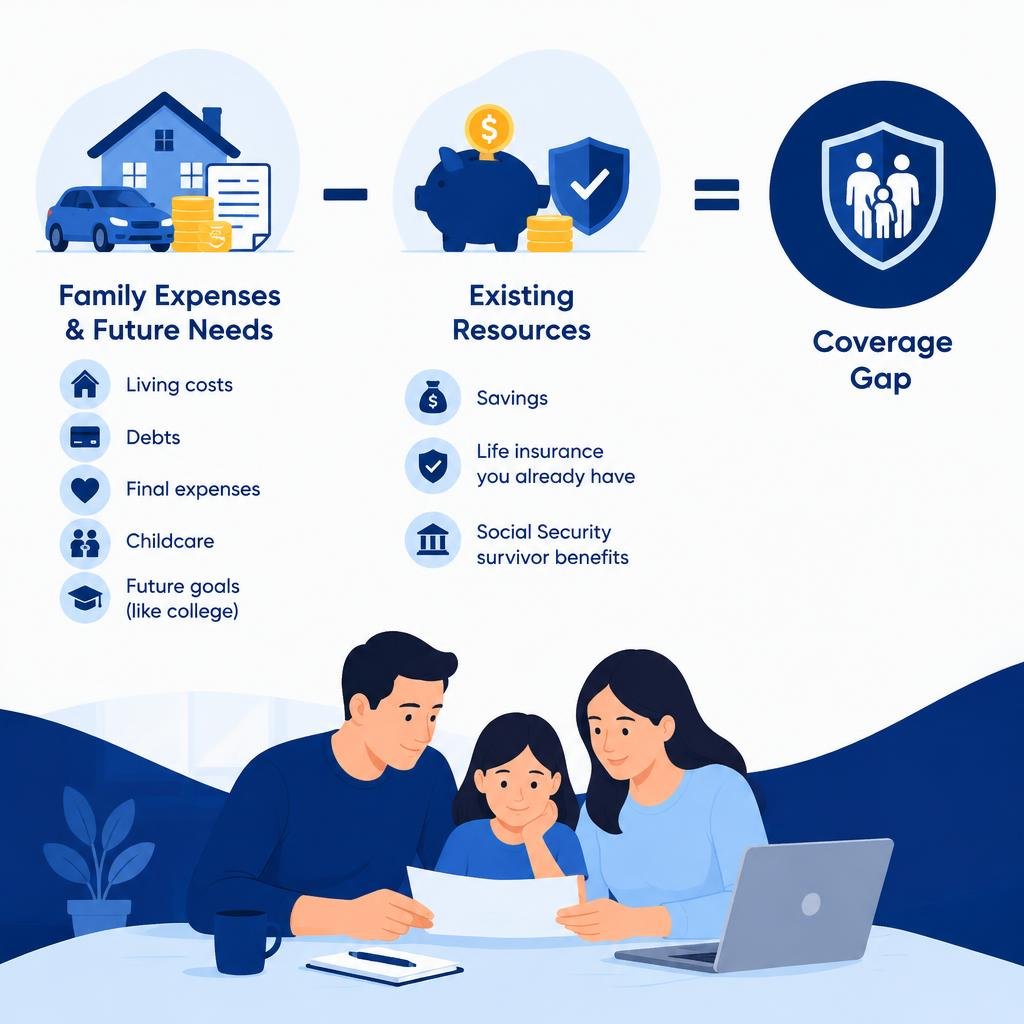
Add up what your family would need if you died: income to cover living costs, debts, final expenses, childcare, and future goals such as college. Then subtract savings, life insurance you already have, and any Social Security survivor benefits your family may qualify for. The gap is a starting point for the coverage you may need to buy.
A rule like 10 times your salary can help you start, but it misses the costs and resources that make your family’s number different.
Leo Truong is a licensed life insurance agent who helps individuals and families understand and review available life insurance options. When families ask how much life insurance they may need, he helps them consider the people and obligations they want to protect.
Basic how much life insurance does a family need terms:
- life insurance for families
- life insurance to cover a mortgage
- should both parents have life insurance
How Much Life Insurance Does a Family Need? Beyond Generic Multipliers
Many households have questions about what amount of life insurance may make sense for their situation.
It is common to hear quick formulas based on a multiple of annual earnings. While a simple multiplier can offer a starting point, it may overlook the financial obligations and available resources that make every household distinct. For example, two households with similar incomes may have very different debt, housing, childcare, and education considerations.
When you rely exclusively on an income multiplier, you risk ending up either underinsured or paying for coverage that does not align with your true priorities. To see if your current safety net matches your obligations, you can consult the definitive guide to knowing if you have enough life insurance for your family.
| Factor | Income-Multiplier Rule of Thumb | Comprehensive Needs-Based Approach |
|---|---|---|
| Calculation Basis | A general multiple of current income | A review of debts, income needs, future goals, and existing resources |
| Debt & Mortgage | Ignored; assumed to fit within the multiplier | Explicitly adds remaining mortgage, auto loans, and personal debts |
| Childcare & College | Ignored; treats every dependent identically | Calculates years of childcare, inflation, and specific tuition goals |
| Existing Resources | Ignored; overlooks liquid savings or group benefits | Credits existing savings, investments, and Social Security survivor benefits |
| Stay-at-Home Parents | May not reflect unpaid household contributions | Considers potential costs to replace household management and childcare |
| Usefulness | Broad starting point | A more individualized way to organize considerations |
Step-by-Step Method to Calculate Family Life Insurance Coverage

There is no single formula that fits every family. A needs-based review may consider immediate obligations, ongoing income needs, future family goals, and available resources. The DIME method, which stands for Debt, Income, Mortgage, and Education, is one general framework that may help organize those considerations.
Understanding what is family protection planning and why you need it helps put these calculations into practical context.
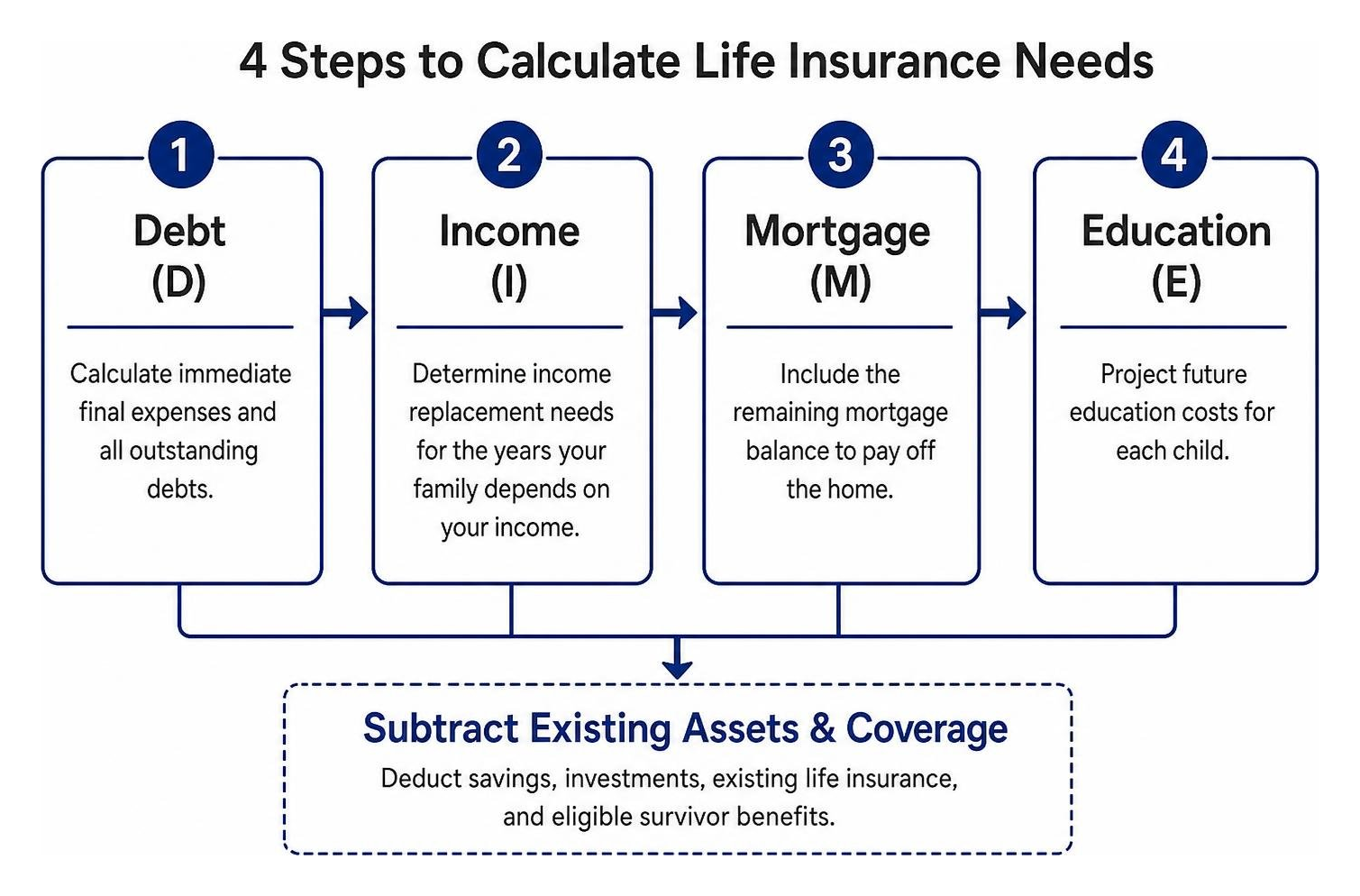
- Consider Immediate Final Expenses and Debts (D): Consider end-of-life expenses and outstanding personal loans, vehicle loans, and credit card balances. Actual costs vary based on personal circumstances and local arrangements.
- Determine Income Replacement Needs (I): Identify how many years of your salary your household would require to maintain stability while the children are growing up.
- Consider Mortgage Goals (M): Families may choose to include some or all of a remaining mortgage balance based on their priorities and the role they want coverage to play.
- Consider Future Education Goals (E): Families may consider education funding goals based on their priorities, the type of school, and the timing they have in mind.
- Subtract Liquid Assets and Existing Coverage: Deduct current savings, taxable investment accounts, existing individual coverage, and eligible survivor benefits from the gross total.
How Much Life Insurance Does a Family Need When Raising Young Children?
Raising young children introduces long horizons of dependency. When deciding on coverage, new parents generally want to ensure that day-to-day household operations remain intact until the youngest child reaches adulthood.
Education may represent a significant future expense. Families who want to include education funding can consider the type of school, the number of children, the anticipated timing, and the resources they expect may be available.
Exploring life insurance for new parents can help families understand their options. Age and health may affect underwriting and the terms available, depending on the insurer and policy.
Consider a hypothetical example: a parent may list an outstanding mortgage, other debts, an amount intended to support the household for a chosen period, and any education goals. The parent can then consider savings, existing coverage, and other resources that may be available. This exercise can help organize questions for a licensed life insurance agent, but it does not produce one universal coverage amount.
A rigid income multiplier may not reflect a family’s debts, future goals, existing resources, or preferred level of support. A more individualized review can help identify questions that a broad rule of thumb may miss.
How Much Life Insurance Does a Family Need for a Stay-at-Home Parent?
One common oversight in family protection planning is failing to insure a non-working or stay-at-home spouse. Even though a stay-at-home parent does not bring home a W-2 paycheck, their daily labor holds immense economic value.
If a stay-at-home parent were to pass away, the surviving working parent would suddenly need to outsource tasks including:
- Infant or after-school childcare
- Daily transportation and carpooling logistics
- Meal preparation and grocery management
- Home upkeep and cleaning services
- Tutoring and educational support
Hiring third-party help to cover these responsibilities may add meaningful household costs. As explored in the complete guide to whether both parents need life insurance, families may evaluate the value of childcare, transportation, household management, and other support when considering coverage for a stay-at-home parent.
Offsetting Coverage Needs with Existing Resources and Social Security
You do not necessarily have to cover every dollar of estimated future need with a private insurance policy. Existing resources may affect how much additional life insurance a family decides to consider.
When reviewing policies, consider beneficiary designations carefully using a comprehensive guide to name life insurance beneficiaries. Existing resources may be relevant when families are considering a coverage amount, including:
- Liquid Savings and Investments: Readily accessible cash accounts, certificates of deposit, and taxable brokerage accounts.
- Retirement Accounts: 401(k) and IRA balances may provide support for a surviving spouse, and access rules and tax treatment vary by account type and individual circumstances.
- Social Security Survivor Benefits: Some surviving spouses and dependent children may be eligible for benefits based on the deceased parent’s earnings record. Eligibility, benefit amounts, and duration vary, so families can review current Social Security information when considering how those benefits may fit into their broader protection planning.
Selecting Policy Types and Structuring Family Protection

Once you establish your family’s coverage target, the next decision is determining which type of policy structure fits your timeline and monthly budget. The two main categories are term life insurance and permanent life insurance (such as whole life or universal life). You can read more about evaluating structures in the definitive guide to comparing family life insurance options.
Term Life vs. Whole Life for Growing Households
Term life insurance and permanent life insurance have different structures, durations, costs, and features. The type that may fit a family depends on its circumstances, goals, budget, and the terms of the policy being considered.
- Term Life Insurance: Uses a defined coverage period chosen in the contract. It is commonly designed without cash value, although available terms, premiums, conversion provisions, and renewal options depend on the policy.
- Whole Life Insurance: Is a permanent coverage design that can include contractual guarantees and cash value provisions. Features such as premiums, cash value growth, dividends, and death benefits depend on the insurer and the specific contract.
A family can weigh the duration of its obligations, the premium commitment, and the policy features it values before selecting a coverage type. For more detail, explore life insurance options and information for families and parents.
Unique Coverage Considerations for Business Owners
Family protection looks slightly different when one or both parents own a small business. In addition to personal household expenses, business owners often have commercial obligations that could impact their personal estates.
- Key-Person Protection: If a business relies on an owner’s specialized skills or client relationships, life insurance may be considered as part of a plan for potential disruption. The policy design and business circumstances affect how any proceeds may be used.
- Buy-Sell Agreements: Life insurance may be used to help fund a buy-sell agreement. The agreement, valuation method, ownership structure, and policy terms determine how a transfer may work.
- Personal Guarantees on Business Debt: Business owners with personal guarantees may want to consider how business obligations could affect the household. Life insurance proceeds may be one resource considered alongside the terms of the debt and the broader business plan.
When to Recalculate Your Family’s Life Insurance Needs
A life insurance calculation is not a one-time task that remains static for three decades. Your family dynamic evolves, debts decline, and income levels change.
Consider reviewing your coverage periodically and after major life changes, such as:
- Welcoming a New Child: May add years of child-rearing and education considerations.
- Buying a Home or Refinancing: Increases or adjusts your total outstanding debt obligations.
- Significant Career Changes: Substantial promotions or career pivots alter your income replacement targets.
- Paying Down Sizable Debts: Eliminating a student loan or car balance lowers your gross coverage need.
- Starting a Business: Introduces commercial liability and business continuity needs.
Frequently Asked Questions About Family Life Insurance Needs
How should a family evaluate employer-provided life insurance?
Workplace coverage may contribute to a family’s overall protection, but its role depends on the available benefit, household responsibilities, and other resources. Each employer plan sets its own eligibility requirements, coverage terms, portability provisions, and conversion options. Reviewing the plan materials can clarify whether additional individual coverage is worth considering.
How much does Social Security survivor benefit reduce life insurance needs?
Social Security survivor benefits may provide monthly income to some eligible minor children and surviving spouses or caregivers. Eligibility, benefit amounts, and duration depend on the deceased worker’s record and the family’s circumstances. Families can consider these benefits as one part of their overall protection picture rather than relying on a fixed reduction in life insurance coverage.
What affects the cost of a term life insurance policy?
Rates for term coverage depend on factors such as age, health history, tobacco use, coverage amount, term length, and individual underwriting. Policy features and available terms also vary by insurer. Reviewing available options can help families understand which policy terms may fit their household budget.
Conclusion
Calculating the right amount of life insurance comes down to evaluating your family’s real debts, income replacement needs, and future education goals, while accounting for the assets you already possess. A needs-based review can help families organize the factors they want to consider when reviewing coverage.
Leo Truong is a licensed life insurance agent who helps individuals and families understand and review available life insurance options.
To review available coverage and explore policies that fit your family’s unique needs, connect with Leo Truong today to explore available life insurance options at Plan With Leo.