Best Life Insurance for Parents: Options, Costs, and Consent Requirements

Best Life Insurance for Parents: Options, Costs, and Consent Requirements
Why Is Having the Right Amount of Life Insurance for Aging Parents So Critical?
If you are asking, “How do I know if I have enough life insurance for my family?” in the context of helping an aging parent, start by listing the specific costs the family would realistically need to handle after that parent’s death, then compare those obligations with existing savings, active policies, and other available resources. There is no universal coverage amount that fits every parent or family. The right amount depends on the parent’s debts, health, budget, policy terms, family support needs, and whether anyone would face a financial burden after the loss.
Adult children often help aging parents review coverage because older policies may have changed, expired, or no longer match the family’s current situation. Exploring coverage options helps families and parents think through late-in-life liabilities without assuming a fixed formula or one-size-fits-all recommendation.
Securing Final Expenses and Medical Bills
A common reason adult children help aging parents review life insurance is to make sure surviving relatives have a plan for costs that may arise near the end of life:
- Final expenses: Funeral, burial, cremation, and administrative costs vary by location, provider, and family preferences. Rather than relying on a national average, families can request local estimates and decide how much of that cost they want insurance to help cover.
- Medical and care obligations: Out-of-pocket medical bills, hospice-related expenses, and transitional care costs may vary depending on health coverage, providers, and the parent’s circumstances.
- Settling remaining debt: Depending on the type of debt, estate assets, state law, and whether an adult child co-signed an obligation, some liabilities may need to be handled by the estate or surviving family members.
Protecting a Surviving Parent’s Living Standard
When one aging parent passes away, household income may change, especially if pension benefits, Social Security benefits, or shared household support are affected. A life insurance policy can provide liquidity that may help a surviving parent manage housing, healthcare, and daily living needs, but the appropriate amount should be based on the family’s actual income sources, expenses, and budget.
How Do I Know If I Have Enough Life Insurance for My Family When Helping an Aging Parent?

Rather than guessing a death benefit, adult children can use a simple obligations-and-resources review to assess an aging parent’s possible coverage gap. Reviewing life insurance options with Leo Truong, a licensed life insurance agent at Plan With Leo, can help families understand and review available life insurance options.
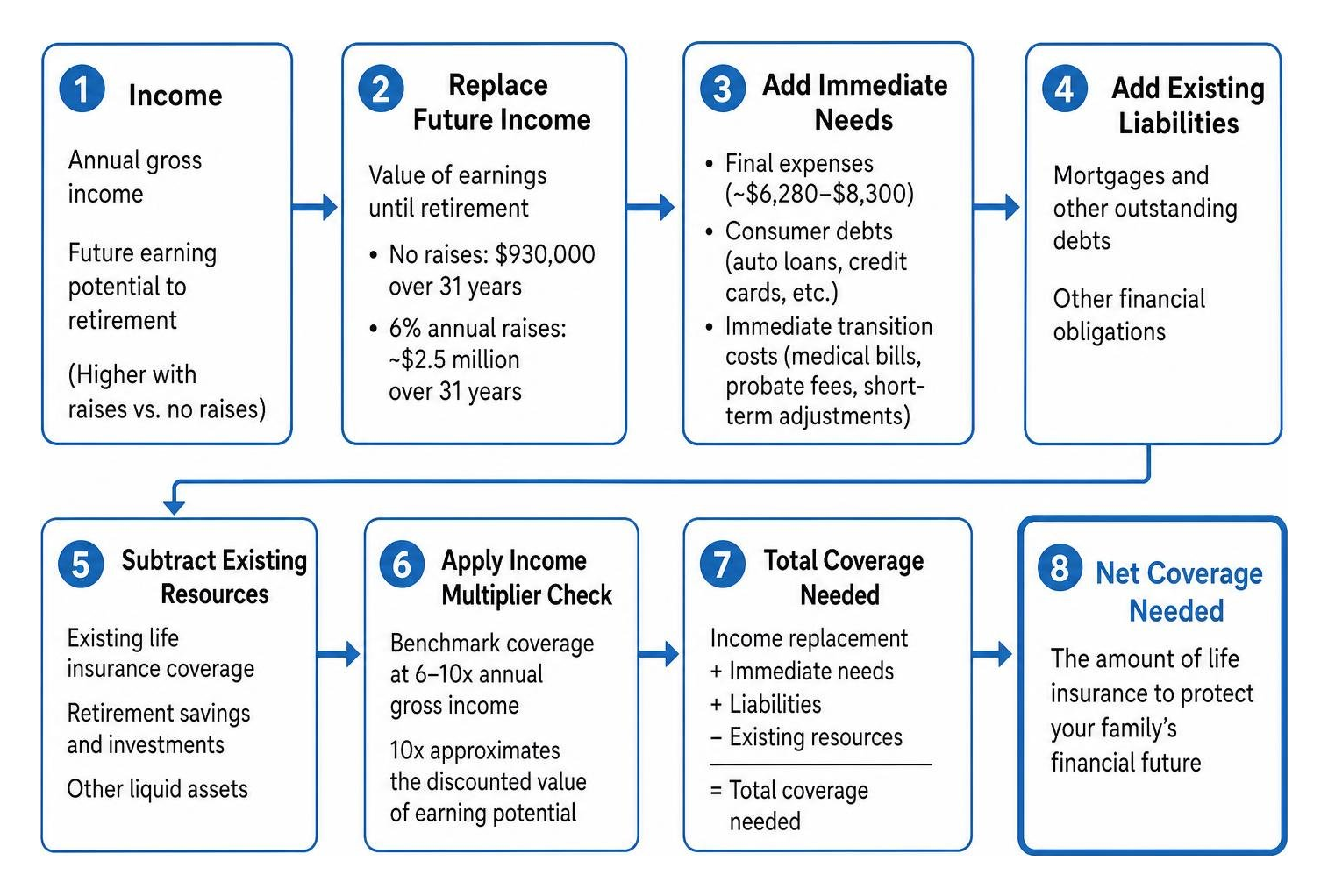
The Senior Obligations Method
For aging parents, life insurance often focuses less on replacing decades of income and more on clearly defined obligations and family support needs. General frameworks such as DIME or income-multiplier methods may be useful conversation starters, but they should not be treated as rules for determining the correct amount of coverage.
Instead, families can review categories such as:
- Final expenses and administrative costs: Costs related to funeral arrangements, burial or cremation, and estate administration.
- Medical or end-of-life bills: Potential uncovered healthcare, prescription, or care-related expenses.
- Remaining debts and housing obligations: Mortgage balances, home equity loans, auto loans, or other obligations that could affect a surviving parent or estate.
- Support for a surviving spouse or dependent family member: Any realistic income or caregiving gap that the family wants insurance to help address.
| Expense Category | What to Review | Why It Matters |
|---|---|---|
| Final Expenses | Local funeral, burial, cremation, and administrative estimates | Helps the family decide how much immediate liquidity may be useful |
| Medical or Unsettled Bills | Potential out-of-pocket health or care-related costs | May reduce the chance that relatives face unexpected bills |
| Remaining Debt | Mortgage, home equity, auto, personal, or co-signed obligations | Clarifies which debts could affect the estate or surviving family |
| Spousal or Family Support | Possible income reduction or caregiving gap | Helps evaluate whether a survivor may need temporary support |
| Existing Resources | Savings, active policies, and other available funds | Prevents overestimating the amount of new coverage needed |
Calculating Net Coverage by Subtracting Existing Assets
To estimate a possible coverage gap, compare the parent’s specific obligations with the resources already available:
$$\text{Possible Coverage Gap} = \text{Estimated Obligations} – \text{Available Resources}$$
Available resources may include:
- Current savings, checking, and accessible non-retirement accounts
- Existing active life insurance policies, including any expiration dates or conversion options
- Survivor benefits or other income sources that may continue
- Retirement savings or other assets the family has already chosen to earmark for final expenses
What Unique Factors Impact Life Insurance for Aging Parents?

Assisting aging parents with coverage involves considerations distinct from planning for younger generations. Contextual guides like life insurance for new parents reflect child-rearing needs, whereas evaluating life insurance need in retirement focuses on fixed incomes, health changes, and legacy goals.
Parental Consent and Insurable Interest
When adult children help aging parents obtain a policy, key legal and underwriting principles may apply:
- Insurable interest: An adult child may need to show that they could experience a genuine financial loss when a parent dies, such as responsibility for funeral expenses, shared debts, or caregiving-related costs.
- Parental consent: In standard individual life insurance, an adult child generally cannot purchase a policy on a parent without the parent’s knowledge and consent. The parent typically participates in the application process and signs required paperwork.
Health Considerations and Underwriting Classes
As parents age, pre-existing health conditions may affect available products, underwriting, and premium rates:
- Fully underwritten policies: For parents in stronger health, standard underwriting may offer more options, though requirements vary by insurer, age, product, and underwriting guidelines.
- Simplified issue policies: These policies may skip a medical exam and rely on health questions, prescription history, and other underwriting information, depending on the insurer.
- Guaranteed issue policies: For aging parents with significant health concerns, guaranteed issue policies may be available without health questions, but they often have higher premiums, limited benefit periods, or graded death benefits that vary by policy.
Strategies detailed in detailed guide to life insurance for stay-at-home parents, the best life insurance strategies for single mothers and fathers, and the complete guide to whether both parents need life insurance illustrate how household roles can shape coverage questions. In any family, both spouses may have financial or caregiving roles worth evaluating, but that does not mean every household needs the same type or amount of coverage.
What Common Mistakes Occur When Sizing Coverage for Aging Parents?
Adult children assisting aging parents frequently run into pitfalls that can result in insufficient protection, unnecessary coverage, or unaffordable premiums:
- Assuming existing term coverage lasts forever: Some aging parents purchased term policies decades ago that may now be expiring, leaving them with fewer options if health has changed.
- Purchasing unnecessarily high coverage amounts: Sizing coverage as if the parent were still a primary wage earner supporting young dependent children can lead to premiums that may not fit the parent’s long-term budget.
- Overlooking graded benefit periods: Buying a guaranteed issue policy without understanding possible waiting periods or graded death benefit rules can create surprises if death occurs soon after purchase.
- Failing to account for affordability on fixed budgets: Because aging parents often live on fixed retirement income, premium affordability matters. A policy only helps if the family can reasonably keep it in force under the policy terms.
- Overlooking longer-term dependent needs: If a parent supports a spouse, adult child, or dependent with ongoing needs, the family may need to consider longer-term support, beneficiary choices, and coordination with appropriate legal, benefits, or tax professionals.
Periodically Reviewing Existing Parental Policies
Reviewing an aging parent’s existing coverage periodically can help avoid surprises by checking:
- Policy expiration dates and any term conversion options
- Premium increase schedules on older permanent, universal, or variable policies
- Current beneficiary designations and whether they still reflect the parent’s wishes
- Whether the coverage amount still matches the parent’s debts, family support needs, and available resources
Should You Choose Term or Permanent Life Insurance for Aging Parents?
Selecting the right policy structure is important when helping aging parents manage premium costs and coverage duration. When comparing family life insurance options, adult children can weigh temporary versus lifelong needs, as explored further in the guide on term vs permanent life insurance costs benefits.
When Term Life Insurance Fits Aging Parents
Term life insurance provides protection for a specific period, subject to the parent’s age, health, insurer eligibility rules, and underwriting.
- Short-term liabilities: Term insurance may be practical if an aging parent has a specific debt with a known end date, such as a remaining mortgage or business-related obligation.
- Age and underwriting limitations: Term policies may become harder to obtain or less affordable as parents get older, depending on carrier age limits, health, and underwriting.
When Permanent or Final Expense Life Insurance Fits
Permanent life insurance, such as whole life or guaranteed universal life, can remain in force for the parent’s lifetime if required premiums are paid and policy terms are followed.
- Potential death benefit for final expenses: Whole life final expense policies may provide funds for burial, cremation, medical bills, or other end-of-life costs, depending on the policy and beneficiary decisions.
- Premium stability: Premiums on some whole life policies are designed to remain level, which may help families budget predictably if the policy stays in force.
| Feature | Term Life for Seniors | Permanent / Final Expense Life |
|---|---|---|
| Coverage Duration | Set term, subject to age limits and policy terms | Potentially lifelong if premiums and policy terms are maintained |
| Primary Use | Temporary liabilities or time-limited family support needs | Final expenses, burial costs, medical bills, or lifelong coverage goals |
| Premium Stability | Often level during the initial term, then may expire or change | May offer level premiums, depending on the policy |
| Medical Underwriting | Often requires standard or simplified underwriting | May be available as simplified issue or guaranteed issue |
Every family’s financial situation and parental health history are unique. If you are helping an aging parent evaluate coverage, Leo Truong, a licensed life insurance agent at Plan With Leo, can help you review life insurance needs and understand available options.