
How Life Insurance to Cover a Mortgage Protects Your Family
Life insurance to cover a mortgage may help provide funds that surviving beneficiaries can use toward the remaining home loan or monthly mortgage payments if a breadwinning parent passes away. Depending on the policy, coverage amount, and household circumstances, it may reduce financial pressure during a difficult time.
Buying a home can be an important part of a growing family’s plans. For new parents, bringing a baby home to a place of their own is a meaningful milestone. Along with homeownership, however, comes a long-term financial commitment: mortgage debt.
When you take out a home loan, you enter into a standard loan amortization schedule where early payments consist mostly of interest, and your home equity builds gradually. If an unexpected tragedy occurs and a breadwinning parent passes away, the remaining family members face the dual burden of grief and ongoing mortgage installments. Without adequate resources, surviving dependents may face added financial pressure while managing ongoing mortgage installments.
Life insurance may provide a source of funds that beneficiaries can use as they decide how to address mortgage and household expenses. Coverage needs and outcomes depend on the policy, beneficiaries, and family circumstances. Our first-time homeowners life insurance guide explains considerations for reviewing coverage early in the homeownership journey.
Mortgage Protection Insurance vs Traditional Life Insurance
When exploring coverage that may help address mortgage debt, you may encounter Mortgage Protection Insurance (MPI) and traditional life insurance. Features, eligibility, beneficiaries, and costs can vary by insurer, lender, state, and policy.
The coverage mechanics of these two options differ significantly:
- Mortgage Protection Insurance (MPI): MPI may be offered through lenders or insurers and can be connected to a mortgage. Depending on the policy, the benefit amount may decline with the loan balance or remain level, and the payment arrangement and beneficiary designation can vary.
- Traditional Life Insurance: Term and permanent life insurance policies may offer level or other benefit structures, depending on the contract. Policyowners generally select coverage and beneficiary options from those available under the policy, subject to underwriting and insurer rules.
Premiums and underwriting approaches differ by product and insurer. Some MPI and traditional life insurance policies use simplified underwriting, while others may involve more detailed health information or medical underwriting. Comparing policy terms, costs, coverage amounts, and beneficiary arrangements can help households understand the available options.
Direct Lender Payouts vs Beneficiary Freedom
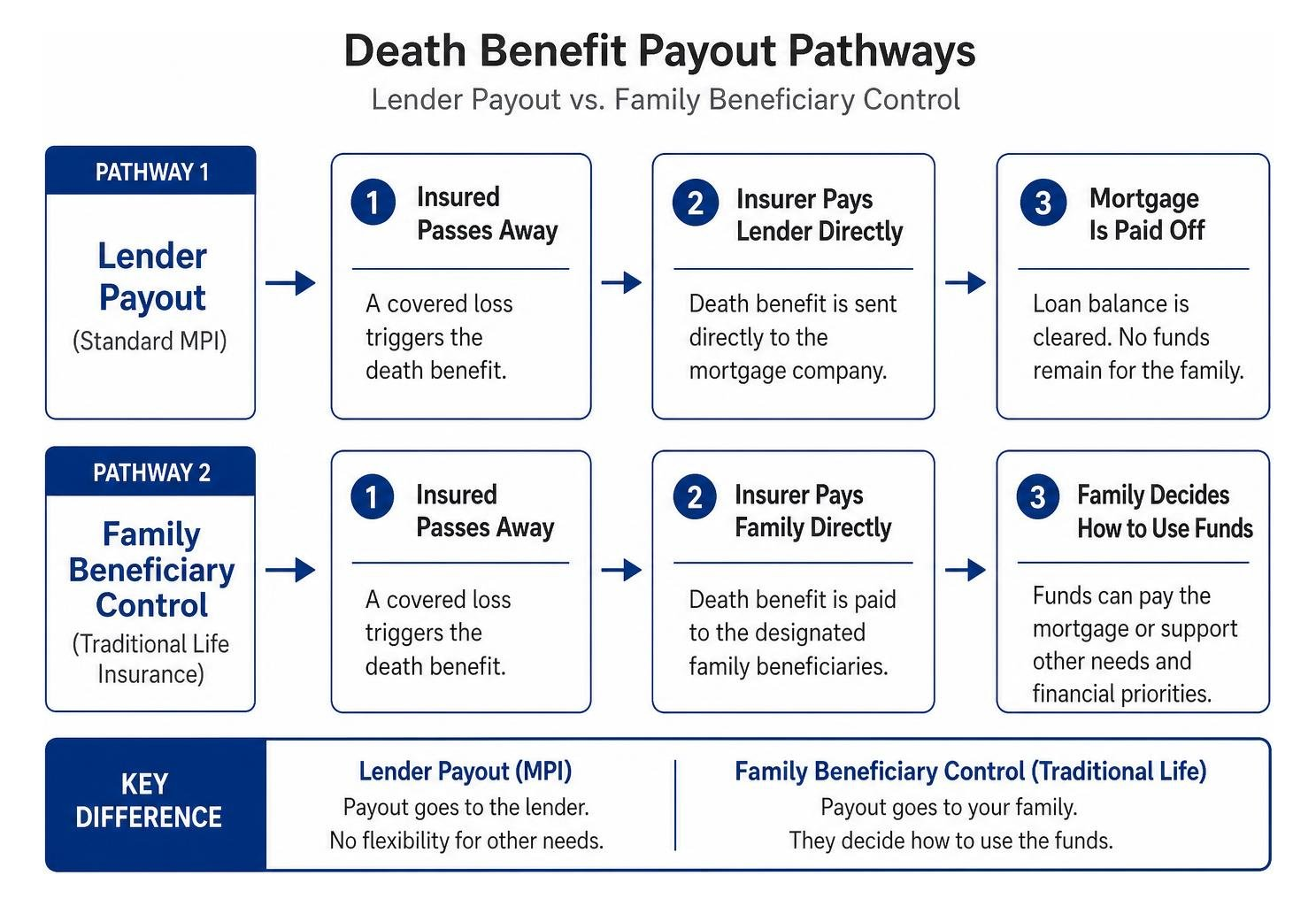
One of the most vital distinctions between policy styles is where the death benefit goes:
- Lender Payment Arrangement (Some MPI Policies): Some MPI policies may direct benefits to a lender or apply benefits toward an outstanding mortgage balance. The arrangement depends on the policy and lender requirements.
- Personal Beneficiaries (Some Traditional Policies): Traditional life insurance policies may name personal beneficiaries, such as a spouse, who receive benefits according to the policy terms.
When personal beneficiaries receive a death benefit, they may have options for using the proceeds under the policy and applicable rules. Depending on their circumstances, they may use funds toward mortgage payments, living expenses, childcare, debt obligations, or other needs.
Comparing Policy Types for Mortgage Protection
Choosing a policy to help address mortgage-related needs involves evaluating policy duration, premium stability, and long-term goals. We help families explore life insurance options that match their household budget and debt profile.
| Policy Feature | Mortgage Protection Insurance (MPI) | Level Term Life Insurance | Permanent Life Insurance (Whole/Universal) |
|---|---|---|---|
| Benefit Amount | May decline with a mortgage balance or follow another policy design | Often level during the selected term, subject to policy terms | May be level or vary by product and policy terms |
| Beneficiary or Payment Arrangement | May involve a lender or another arrangement specified in the policy | May name personal beneficiaries, subject to the policy | May name personal beneficiaries, subject to the policy |
| Premium Structure | Varies by insurer, underwriting, coverage, and policy design | Varies by insurer, underwriting, coverage, and term length | Varies by product, funding design, underwriting, and policy terms |
| Cash Value | Often not included, but policy features vary | Typically does not include cash value | Some policies may build cash value, subject to charges and policy performance |
| Use of Benefits | May be tied to mortgage-related terms or another payment arrangement | Depends on beneficiary designations and policy terms | Depends on beneficiary designations and policy terms |
| Underwriting | May be simplified or more detailed, depending on the insurer | May be fully underwritten or simplified | May be fully underwritten or simplified |
Level Term vs Decreasing Term Coverage
When comparing term products, buyers usually choose between level term policies and decreasing term policies (often structured as decreasing mortgage life insurance).
- Decreasing Term Coverage: The death benefit may reduce over time, often to align with a declining mortgage balance. Premiums, benefit schedules, and policy terms vary, so households may want to review whether the changing benefit matches their anticipated needs.
- Level Term Coverage: A level term policy generally keeps the stated death benefit level for the selected term, subject to policy terms and premium payments. If the mortgage balance declines, a level benefit may leave funds available for other household needs, depending on beneficiary decisions and the policy.
Using Permanent Life Insurance to Cover a Mortgage
Term and permanent life insurance can serve different coverage goals. Permanent coverage, such as whole life or universal life, may be considered as part of a household’s broader life insurance review, depending on the policy design, costs, and coverage needs.
Permanent policies may provide coverage for life if required premiums are paid and the policy remains in force. Some policies may build cash value under their terms. Access to cash value depends on the policy, and loans or withdrawals may reduce cash value or the death benefit and may have policy or tax consequences. Review the policy contract and consult appropriate qualified professionals for questions about those consequences.
To understand these trade-offs, explore our resources on comparing term and permanent life insurance costs and benefits and evaluating cash value versus term life policies.
Joint Life Insurance Policies for Married Couples
New parents buying a home together often consider how to structure coverage for two breadwinners:
- Joint First-to-Die Policies: A single policy may cover both partners and pay a benefit when the first insured person dies, according to its terms. After a payout, the policy may end, so households may want to review what coverage remains for the surviving partner.
- Individual Policies: Each parent may hold a separate policy. If one insured person dies, the other policy may remain in force if its premiums are paid and its terms are met. The appropriate structure depends on household needs, policy terms, underwriting, and cost.
You can learn more about securing life insurance coverage for families to see how individual coverage may fit the needs of both parents.
How to Determine the Right Coverage Amount and Policy Term
Calculating how much coverage you need requires looking beyond the loan balance on your monthly statement. A mortgage is often a household’s largest debt, but it does not exist in a vacuum.
Sizing Your Policy Beyond the Loan Balance
When estimating a possible death benefit amount, consider multiple financial factors:
- Mortgage Principal and Property Taxes: Account for the full remaining mortgage balance, plus estimated property taxes and homeowners insurance over a transitional period.
- Income Gap and Childcare Costs: If a parent passes away, the surviving spouse may need help funding full-time childcare, preschool tuition, and daily household maintenance.
- Outstanding Debts: Include auto loans, student loans, and credit card balances.
- Education Funds: Factor in future savings targets for your children’s schooling or college funds.
- Emergency Reserves: Provide a liquid cushion so the surviving parent is not forced into immediate financial decisions.
Choosing Life Insurance Coverage to Address a Mortgage
Matching the policy term to your loan structure is the most common approach:
- 30-Year Fixed Loans: A 30-year level term policy may align with the length of a 30-year mortgage, depending on the household’s coverage goals and policy terms.
- 15-Year Fixed Loans: A 15- or 20-year term policy may align with a shorter amortization schedule. Premiums depend on factors such as the insurer, coverage amount, term length, age, health, and underwriting.
Some families may explore policy layering, also called laddering, as one optional way to combine policies with different term lengths. For example, a household might consider a longer-term policy for mortgage-related needs alongside a shorter-term policy for temporary childcare or other household expenses. Whether this structure fits depends on the policies and the family’s circumstances.
Essential Policy Riders and Underwriting Considerations

Some life insurance policies may offer optional riders that provide benefits under qualifying circumstances, depending on the policy and rider terms.
Medical Underwriting Requirements
The underwriting process directly influences what you pay:
- Fully Underwritten Policies: May involve a health questionnaire, records review, and, in some cases, a medical exam. Available rates and approval decisions depend on the insurer’s underwriting process and the applicant’s circumstances.
- Simplified Issue Policies: May use health questions, records, or other information without requiring a medical exam. Processing time, eligibility, premiums, and coverage amounts vary by insurer.
- Guaranteed Acceptance Policies: May have limited or no health questions, but coverage limits, waiting periods, costs, and eligibility rules vary by insurer and policy. Review the contract carefully to understand how the policy works.
Accelerated Death Benefits and Critical Illness Riders
Some living-benefit riders may allow policyholders to access part of a death benefit under specified circumstances. Availability, definitions, eligibility triggers, costs, and effects on the death benefit vary by insurer, state, and policy:
- Terminal Illness Benefit: Some policies include an accelerated benefit when an insured person meets the policy’s definition of terminal illness. Terms, costs, and benefit amounts vary.
- Critical or Specified Illness Cover: Some riders may provide a benefit when an insured person is diagnosed with a condition defined in the policy, such as certain cancers, heart attacks, or strokes. Policy terms determine the covered conditions, eligibility, and use of any benefit.
- Chronic Illness / Disability Riders: Some policies may include riders that waive premiums or provide benefits when an insured person meets the policy’s chronic illness or disability criteria. Features and limitations vary.
Availability and terms for these riders vary by insurer, state regulations, and individual underwriting.
Frequently Asked Questions
Can life insurance be used for living expenses in addition to mortgage payoff?
When a traditional life insurance policy names personal beneficiaries, benefits may be paid to them according to the policy terms. Subject to applicable rules and the policy, beneficiaries may use proceeds toward a mortgage, regular household expenses, childcare, vehicle loans, education savings, or other needs.
Is mortgage protection insurance more expensive than term life insurance?
Costs for mortgage protection insurance and term life insurance vary by insurer, underwriting, benefit amount, term length, policy design, and other factors. Some MPI policies use simplified underwriting, while term life policies may use fully underwritten or simplified processes. Reviewing comparable quotes and policy terms can clarify the differences for a particular household.
What happens to the policy if I pay off my mortgage early?
With a traditional level term or permanent life insurance policy, coverage may continue after you sell the home or pay off the loan if the policy remains in force and required premiums are paid. The death benefit, beneficiaries, and other features remain subject to the policy terms. Some mortgage-linked MPI policies may end or change when the underlying mortgage is paid off, so review the contract and lender requirements.
Conclusion
Reviewing life insurance alongside a mortgage can help homeowners understand how a death benefit may be used if a family member dies. Mortgage protection insurance and traditional life insurance have different structures, and the available benefits, beneficiaries, and costs depend on the policy terms.
Plan With Leo helps individuals and families understand and review available life insurance options. As a licensed life insurance agent, Leo Truong provides educational guidance to help you review policy choices with clarity and confidence. Explore our life insurance guide to learn more about life insurance fundamentals, or reach out today to review your available options.