How to Evaluate Life Insurance Necessity for Both Parents in X Simple Steps

How to Evaluate Life Insurance Necessity for Both Parents in X Simple Steps
Should Both Parents Have Life Insurance? Start With What Each Loss Would Cost
In many families, both parents should consider life insurance if either parent’s death would create financial strain, new expenses, or a gap in household support. That may include lost income, remaining debts, childcare costs, mortgage payments, education funding, or daily household responsibilities that would need to be replaced.
Start by asking these five questions for each parent:
- What income, benefits, or household support would be reduced or lost after that parent’s death?
- What final expenses, medical bills, or end-of-life costs may need to be handled?
- Which debts, mortgage payments, taxes, or monthly bills would remain?
- Would the surviving parent need paid help with childcare, transportation, home maintenance, or daily household tasks?
- Who would receive and manage the proceeds, and are beneficiary designations current?
Coverage does not need to be identical. One parent may need more coverage because the family depends on their income, while the other may need a policy focused on replacing the value of caregiving, household management, or other unpaid contributions. The right answer depends on each parent’s role, health, budget, obligations, and the type of policy available through underwriting.
Leo Truong is a licensed life insurance agent who helps buyers understand and compare available life insurance options for family protection, income replacement, and household obligations. This guide explains how to evaluate whether both parents should have coverage when choosing life insurance to protect a growing family.

Related Plan With Leo resources for other family situations include:
- life insurance for stay at home parents
- life insurance for single parents
- life insurance underwriting
Step 1: Why and When Should Both Parents Have Life Insurance?
When parents start a family, the conversation about life insurance often begins with one question: what would happen financially if Mom or Dad passed away? A common myth suggests that only the parent with the larger salary or primary income needs protection. In many households, financial stability relies on both parents through income, caregiving, home management, transportation, and shared bills.
Assessing Dual-Income Households
Dual-income couples often build their household budget around two paychecks. If one parent dies, the surviving spouse may still face mortgage payments, rent, utilities, insurance premiums, childcare costs, taxes, transportation expenses, and medical bills. Some income sources may continue, but the loss of one salary can create an immediate gap between what the family earns and what it needs.
If one source of support suddenly disappears, the surviving parent may face grief while also trying to maintain housing, childcare, and daily stability. Evaluating life insurance coverage for families and parents means looking closely at:
- Income Replacement: Would the surviving parent lose income or benefits that helped cover regular household expenses?
- Mortgage Liabilities and Shared Debt: Would the surviving parent need to pay off a mortgage, car loans, credit cards, student loans, or other remaining obligations on a single income?
- Future Costs: Would proceeds help cover childcare, education funding, daily living expenses, or other support needed after one parent’s death?
Insuring both parents may help reduce the chance that one death shifts immediate financial pressure to the surviving spouse or extended family.
Stay-at-Home Parents and Caregivers

A frequent misconception is that a stay-at-home parent does not need life insurance because they are not earning a traditional paycheck. However, economic value is not defined solely by employment income.
A stay-at-home parent may provide important household support, including:
- Managing daily childcare and school schedules
- Preparing meals and maintaining the home
- Driving children to activities and appointments
- Handling bills, household logistics, and family coordination
If that parent passes away, the surviving parent may need to hire help for childcare, meal preparation, home maintenance, and transportation. These services can create significant new expenses at the same time the family is handling funeral costs and adjusting to a single-parent household.
A detailed guide to life insurance for stay at home parents explains the broader idea that unpaid household labor can have real replacement value. For families with a stay-at-home parent, coverage should reflect the practical support that would be lost, not only traditional income.
Step 2: Quantify Protection Needs Across Life Stages
Determining how much life insurance each parent needs is not a one-size-fits-all calculation. Families should focus on the specific costs that may arise after each parent’s death and the policy types realistically available based on age, health, budget, state availability, and underwriting.
Balancing Coverage Amounts for Working Parents and Caregivers
To determine policy sizes, families often balance direct financial support against unpaid caregiving and household responsibilities. One parent may need more coverage because the household depends on their income, while the other may need a policy sized to replace the cost of childcare, home management, and daily household tasks.
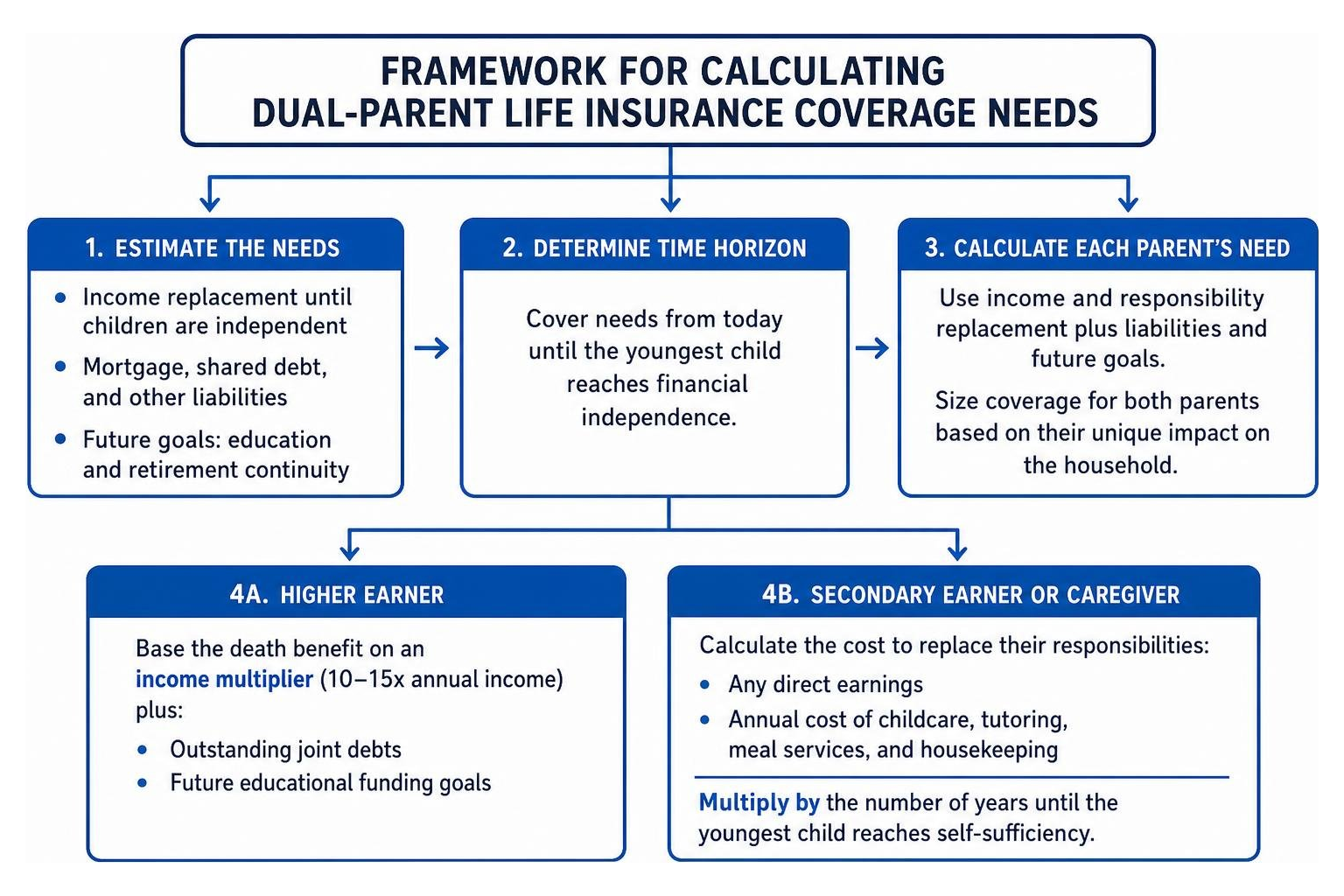
When establishing coverage amounts, consider the following elements:
- The Parent Providing More Income: Review salary, benefits, and retirement contributions that would stop after death, along with remaining debts and household bills.
- The Parent Providing More Care or Home Support: Estimate the cost of replacing childcare, transportation, meal preparation, bill management, and home maintenance if the surviving spouse can no longer rely on that support.
- Potential Medical and Final Expenses: Consider funeral costs, burial or cremation expenses, possible medical bills, and other expenses the family may need to address.
- Policy Availability and Affordability: Coverage amounts, underwriting requirements, and premium options vary by insurer, age, health, state, and product type.
If you are a new parent just starting to explore coverage, life insurance for new parents covers additional considerations for young families. For all parents, the main focus is usually income replacement, childcare costs, debts, and whether coverage fits the household budget.
Step 3: Choose Between Separate, Joint, Term, and Permanent Policies
Once parents understand the coverage need, the next step is choosing a policy structure that fits the family’s goals, budget, health profile, and available underwriting options.
Individual Policies vs. Joint Coverage
Couples often buy two separate individual life insurance policies because each parent may have different coverage needs, health histories, beneficiary goals, and budgets. Separate policies can also make it easier to size coverage differently for each parent.
Some couples may also compare joint life insurance options where available. A first-to-die policy may provide one payout after the first covered spouse dies, while a second-to-die or survivorship policy generally pays only after both covered people have passed away. For parents mainly trying to protect a surviving spouse and children after the first death, survivorship coverage is usually less direct because it does not provide an immediate death benefit to the surviving parent.
For most families asking whether both parents should have coverage, the practical comparison is simple: does each parent need their own protection based on income, caregiving, debts, and household responsibilities? Availability and pricing vary by insurer, age, health, state, and product design.
Evaluating Term vs. Permanent Life Insurance Options
In addition to choosing between individual and joint structures, parents must decide between term life and permanent life insurance where available.
- Term Life Insurance: Provides coverage for a specific period, such as 10, 15, 20, or 30 years, depending on insurer availability and eligibility. Many new parents choose a term length that covers the years until their children are financially independent. Some term policies include a conversion privilege, but conversion deadlines and eligible products vary by policy.
- Permanent Life Insurance (Whole or Universal Life): Offers lifelong coverage if premiums and policy requirements are met. Some permanent policies include cash value, while others are designed more narrowly for guaranteed death benefit protection. Costs, guarantees, cash value features, and underwriting vary by product.
For a deeper dive into these policy mechanics, review the definitive guide to term vs permanent life insurance costs benefits.
Step 4: Structure Beneficiaries Clearly
Securing policies for both parents is only half the equation. Beneficiary designations help determine who receives the life insurance proceeds, so they should be reviewed carefully and kept current.
Keep Beneficiary Choices Current
A critical fact of life insurance is that beneficiary designations on file with the insurance carrier generally control who receives the death benefit. If a policy still lists an outdated beneficiary, the proceeds may not go where the family expects.
Key beneficiary steps for parents include:
- Naming Primary and Contingent Beneficiaries: Parents often name each other as primary beneficiaries and list a backup beneficiary in case both parents pass away.
- Reviewing Outdated Designations: Divorce, remarriage, the birth of a child, or the death of a beneficiary may require updates to policy records.
- Planning Carefully for Minor Children: Life insurance companies generally cannot pay large death benefits directly to minor children. Parents may need to work with qualified legal guidance if they want proceeds managed for a child.
- Coordinating With Family Documents: Wills, guardianship decisions, and other family documents should be reviewed with appropriate professionals so they do not conflict with beneficiary goals.
Step 5: Avoid Common Mistakes in Dual-Parent Life Insurance Planning
Parents choosing life insurance for their family should avoid several common pitfalls:
- Waiting Until Health Changes: Life insurance availability and pricing often depend on age, health history, medications, and underwriting. Waiting can reduce options or increase costs.
- Assuming Only One Parent Needs Coverage: Even if one parent has more income, the other may provide childcare, transportation, meal preparation, household management, or other support that would be expensive to replace.
- Overlooking Existing Policies: Before buying new coverage, review any existing term, whole life, universal life, employer, or group policies to understand current death benefits, premiums, beneficiaries, and expiration dates.
- Failing to Update Beneficiary Designations: Major life events, such as divorce, remarriage, the birth of a child, or the death of a beneficiary, require updates to policy records.
- Letting Term Conversion Windows Expire: If a parent already owns a term policy, a conversion option may allow a move to permanent coverage without new medical underwriting, but deadlines and eligible products vary by policy.
- Choosing Coverage Without Reviewing Affordability: A policy only helps if premiums remain manageable. Families should compare available options and avoid coverage amounts that are not sustainable for the household budget.
Frequently Asked Questions About Dual-Parent Life Insurance
Do both parents need identical life insurance coverage amounts?
No. Coverage amounts should be customized to reflect each parent’s financial and practical role in the household. One parent may need a larger policy because the family depends on their income and benefits. The other may need a smaller policy focused on replacing the value of childcare, household management, transportation, or other unpaid contributions.
Should a stay-at-home parent have life insurance?
A stay-at-home parent may need coverage if the surviving parent would have to pay for childcare, transportation, meal preparation, home maintenance, or other support after that parent’s death. The coverage amount does not have to match an income-earning parent’s policy, but it should reflect the practical costs of replacing that support.
Should parents choose separate or joint life insurance policies?
Many parents use separate policies because each parent may need a different coverage amount or qualify differently based on age, health, budget, and underwriting. Joint policies may be available in some situations, but parents should compare whether the payout structure actually protects the surviving spouse and children when support is needed most.
Conclusion
Evaluating whether both parents need coverage comes down to assessing household risk and the financial impact of each parent’s death. For families choosing life insurance, the key is to review income replacement needs, remaining debts, childcare and household costs, beneficiary designations, and available policy options.
Plan With Leo helps individuals, families, and business owners understand and compare available life insurance options. Leo Truong is a licensed life insurance agent who provides helps families understand and compare available life insurance options. Plan With Leo does not provide financial planning, investment advisory, tax, or legal services.
To explore available life insurance options for your family, take the next step and compare family life insurance options today.