What Is the Difference Between Term and Permanent Life Insurance?

What Is the Difference Between Term and Permanent Life Insurance?
What Is the Main Difference Between Term and Permanent Life Insurance?
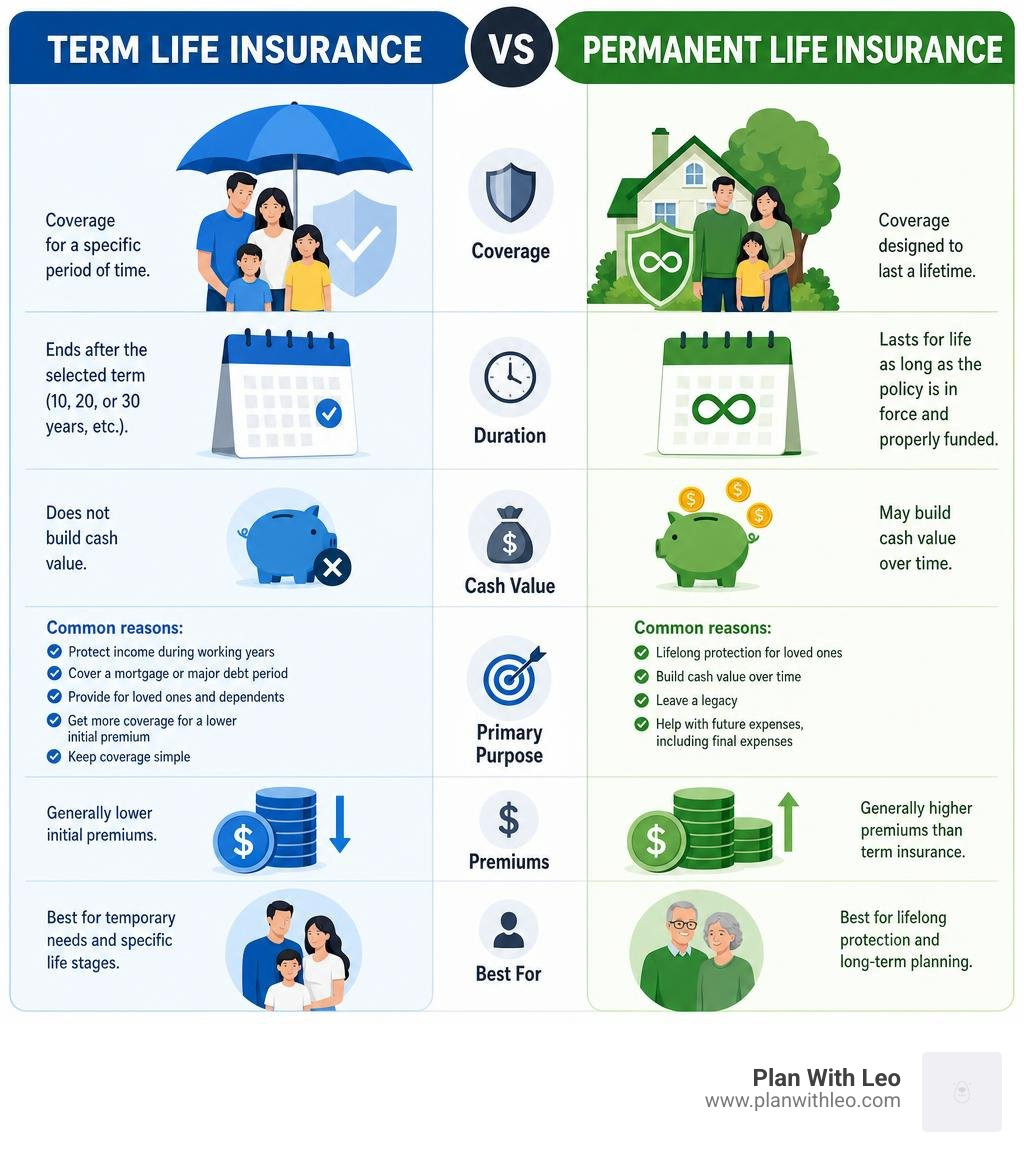
Term life insurance and permanent life insurance both provide a death benefit to beneficiaries if the insured person passes away while the policy is active. The main difference is how long the coverage is designed to last.
Term life insurance provides coverage for a set period, such as 10, 20, or 30 years, depending on the insurer, product, age, health, and underwriting. It is often chosen to cover temporary needs, such as income protection during working years, a mortgage period, childcare years, or other years when loved ones would be financially vulnerable.
Permanent life insurance is designed to last for life, as long as required premiums are paid and the policy remains in force. It usually costs more than term coverage because it can provide lifelong protection and may build cash value over time.
For many individuals, couples, families, and homeowners, the decision is not about which type is universally better. It is about which type fits the reason for buying coverage, how long protection is needed, and what premium is realistic to maintain.
What Is Term Life Insurance?
Term life insurance is temporary life insurance. The policy stays active for a selected term, and if the insured person dies during that term, the beneficiaries generally receive the policy’s death benefit.
People often consider term life insurance when they want straightforward coverage for a specific window of time. For example, an individual, couple, family, or homeowner may want coverage during years when income, mortgage payments, childcare costs, or other obligations would be difficult for loved ones to manage alone.
Common reasons someone might consider term life insurance include:
- Protecting income during working years
- Covering a mortgage or other major debt period
- Helping a spouse, partner, children, or dependents maintain stability
- Getting a larger death benefit for a lower initial premium than many permanent policies
- Keeping coverage simple and easy to understand
Term life does not usually build cash value. If the policy ends and the insured person is still living, coverage generally stops unless the policy allows renewal, conversion, or another option. Those options vary by insurer and policy.
What Is Permanent Life Insurance?
Permanent life insurance is life insurance designed to provide long-term or lifelong coverage, as long as the policy is properly funded and remains in force. Unlike term coverage, it is not meant to end after a fixed 10-, 20-, or 30-year period.
Permanent life insurance may also include a feature called cash value. Cash value is a part of the policy that can grow over time according to the terms of the contract. Depending on the policy, the owner may be able to access some of that value through withdrawals, loans, or surrendering the policy. These options can reduce the death benefit, create fees or interest, or cause other consequences, so they should be reviewed carefully before use.
Common types of permanent life insurance include:
- Whole Life Insurance: Often has fixed premiums, a guaranteed death benefit, and cash value features, depending on the policy.
- Universal Life Insurance: May allow more flexibility in premiums or death benefits, but it usually requires ongoing review to keep the policy properly funded.
- Final Expense Insurance: A smaller permanent policy often used to help cover end-of-life costs.
People may consider permanent life insurance when they want coverage that can remain in place for life rather than coverage for only a temporary period.
How Do Costs Compare Between Term and Permanent Life Insurance?
Price is often one of the biggest differences between term and permanent life insurance. Term life is usually more affordable at the start because it covers a limited period and does not typically include cash value. Permanent life insurance usually costs more because it is designed to remain in force for life and may include cash value features.
The exact premium for either type depends on many factors, including age, health, coverage amount, policy type, insurer, state, and underwriting results. For that reason, it is better to compare actual policy options rather than rely on a single generic price example.
| Feature | Term Life Insurance | Permanent Life Insurance |
|---|---|---|
| Coverage length | Temporary coverage for a selected term | Designed for lifelong coverage if requirements are met |
| Premiums | Often lower at the start for the same death benefit | Usually higher because coverage can last for life |
| Cash value | Typically none | May build cash value over time |
| Complexity | Generally simple | More complex because of cash value, fees, and policy rules |
| Common use | Temporary protection for income, mortgage, or family obligations | Long-term protection, final expenses, or lifelong coverage goals |
How Cash Value Works in Permanent Policies
Cash value is one reason permanent life insurance is more complex than term life insurance. It is a policy feature that may grow over time according to the contract. The growth method, guarantees, fees, and access rules vary by policy type and insurer.
Some policyowners may be able to access cash value through withdrawals, loans, or surrendering the policy. However, using cash value can reduce the death benefit, create fees or interest, affect how long the policy stays in force, or create other consequences. Anyone considering a permanent policy should ask for a clear explanation of how the cash value works before buying.
Fitting Life Insurance Premiums Into Your Budget
A life insurance policy is only useful if the premium is realistic to maintain. A lower-cost term policy may allow someone to secure more death benefit during the years when coverage is most needed. A permanent policy may be appropriate when someone wants lifelong coverage and is comfortable with the higher ongoing cost.
Leo Truong is a licensed life insurance agent who helps people understand and compare available life insurance options. Comparing term and permanent coverage side by side can make it easier to see which policy structure fits the coverage goal and budget.
What Are the Pros and Cons of Term vs Permanent Coverage?
Selecting the right policy type starts with understanding the trade-off between temporary affordability and long-term coverage. A policy that works well for a mortgage period or dependent years may not be the same policy someone chooses for lifelong protection or final expenses.
Pros and Cons of Term Life Insurance
Term life insurance can be useful when the coverage need has a clear time frame, such as the years until a mortgage is paid off, children become financially independent, or a surviving spouse or partner would have other resources available.
Advantages of Term Life Insurance:
- Lower Initial Cost: Term coverage typically offers more death benefit per premium dollar than permanent coverage.
- Simple Structure: Term policies are generally easier to understand because they do not include cash value accounts or complex policy funding rules.
- Targeted Protection: Term insurance can align with finite obligations, such as a remaining mortgage balance, income replacement years, or other time-limited responsibilities.
Disadvantages of Term Life Insurance:
- Temporary Expiration: If the policyholder outlives the selected term, coverage generally ends unless another option is available.
- No Equity Build-Up: Premiums paid into most term policies do not create cash value or living policy value.
- Costly Renewal Rates: Extending coverage after the initial term may be expensive because renewal rates often rise with age.
Term life insurance may make sense when the goal is affordable protection during a clearly defined period rather than guaranteed lifetime coverage.
Pros and Cons of Permanent Life Insurance
Permanent life insurance offers long-term continuity and may include cash value, but it requires a higher and more sustained premium commitment. That trade-off should be reviewed carefully before choosing a policy.
Advantages of Permanent Life Insurance:
- Lifelong Coverage Potential: Permanent coverage is designed not to expire as long as required policy obligations are met.
- Cash Value Features: Many permanent policies can build cash value that may be accessed during the policyowner’s lifetime, subject to contract rules and potential consequences.
- Long-Term Protection: Permanent insurance may be useful for people who want coverage that does not end after a selected term.
Disadvantages of Permanent Life Insurance:
- Higher Cost: Permanent premiums are usually much higher than term premiums for the same death benefit.
- Surrender Charges or Fees: Canceling or changing a permanent policy may involve charges or reduced cash value availability, depending on the contract.
- Contract Complexity: Permanent policies can require ongoing review to make sure premiums, fees, cash value, and coverage remain on track.
For a broader overview of coverage options, visit Plan With Leo’s life insurance resource.
How Do You Decide Which Life Insurance Policy Fits Your Goals?
Choosing between term and permanent life insurance starts with the reason for buying coverage. Consider how long protection is needed, who depends on the insured person, what obligations would need to be covered, and what premium can be maintained over time.
Who Should Consider Term Life Insurance?
Term life insurance is usually practical when someone needs coverage for a temporary financial obligation and wants to keep premiums as manageable as possible. It is designed for defined risk windows where a death during the term would create immediate financial strain for loved ones.
You may consider term life insurance if you are:
- Protecting Income: If someone depends on your income for daily expenses, housing, childcare, or other needs, term coverage can provide protection during key working years.
- Carrying a Time-Limited Debt: Term coverage can be matched to a remaining mortgage, home equity loan, or other debt expected to decline or disappear within a set number of years.
- Budget-Conscious but Underinsured: If permanent coverage is too expensive, a term policy may allow you to secure a larger death benefit during the years when financial exposure is highest.
Coverage availability, premium levels, and term length options vary by insurer, age, health, state, and underwriting outcome, so it is important to compare options carefully before assuming a specific policy will be available.
Who Should Consider Permanent Life Insurance?
Permanent life insurance is usually considered when someone wants coverage that can stay in place for life rather than coverage tied to a temporary term window.
You may consider permanent life insurance if you:
- Want Lifelong Protection: Permanent coverage may be appropriate if you do not want life insurance to end after a fixed term.
- Want Final Expense Coverage: A smaller permanent policy may help provide funds for funeral costs or other end-of-life expenses.
- Have an Ongoing Coverage Need: Some people want coverage that continues regardless of age, as long as the policy stays in force.
- Understand the Policy Features: Permanent coverage may be worth considering if you are comfortable with higher premiums and understand how the cash value, fees, and policy rules work.
Can You Combine or Convert Policies Later?
Choosing life insurance is not always an all-or-nothing decision. Some people use more than one policy type to match different coverage needs.
- Term-to-Permanent Conversion Riders: Some term life contracts include a conversion option. This may allow the policyowner to convert all or part of a term policy into a permanent policy before a deadline, often without new medical underwriting. Conversion rules vary by insurer and policy.
- Policy Layering: Some people combine a larger temporary term policy with a smaller permanent policy. The term component may cover temporary obligations, while the permanent component may remain in place for long-term coverage or final expenses.
Whether combining policies makes sense depends on personal needs, budget, and available policy options.
Common Questions Before Choosing Coverage
Is term or permanent life insurance better?
Neither type is automatically better. Term life is often better for temporary, budget-conscious protection. Permanent life may be better for someone who wants coverage that can last for life and is comfortable with higher premiums and added complexity.
What happens when term life insurance ends?
When the term ends, coverage generally ends too. Some policies may allow renewal or conversion to permanent coverage, but those options vary by insurer, product, and policy rules.
Does permanent life insurance always build cash value?
Many permanent policies include cash value, but how it works depends on the type of policy. Cash value growth, access, fees, and risks should be explained clearly before buying.
Can I switch from term to permanent life insurance?
Some term policies include a conversion option that may allow the owner to convert part or all of the coverage to permanent insurance before a deadline. Conversion rules vary by policy and insurer.
How can I compare my options?
Start by asking how long you need coverage, who depends on you, what premium you can maintain, and whether you want simple temporary protection or lifelong coverage. You can learn more through Plan With Leo’s Life Insurance resources, review common questions on the FAQ, or contact Leo Truong for help comparing available life insurance options. Leo Truong is a licensed life insurance agent who helps people understand and compare coverage choices.
Final Thoughts on Term Life vs. Permanent Life Insurance
Term life and permanent life insurance can both help protect loved ones, but they are built for different needs. Term life is usually simpler and more affordable for temporary coverage periods. Permanent life is usually more expensive and more complex, but it may provide coverage that can last for life.
The best choice depends on why coverage is needed, how long it should last, and what premium can be maintained. A licensed life insurance agent can help explain policy options, compare term and permanent coverage, and identify which structure may fit the situation.