The Complete Guide to Life Insurance for Vietnamese Small Business Owners in California

The Complete Guide to Life Insurance for Vietnamese Small Business Owners in California
How Can Life Insurance Help Vietnamese Small Business Owners in California Protect Both Their Family and Business?
Life insurance can help Vietnamese small business owners in California protect both their family and business by serving as a potential source of financial liquidity. Depending on policy ownership, beneficiary structure, business obligations, and the circumstances, policy proceeds may help a family address personal needs or help a business manage expenses, debt obligations, or a transition after the death of an owner.
Running a small business in California requires dedication, resilience, and sharp financial management. Whether you operate a restaurant in Little Saigon, a medical practice in Orange County, or a logistics firm in the Bay Area, your daily efforts build both enterprise value and family wealth. However, California’s commercial environment presents distinct economic hurdles—from high real estate and lease costs to strict operating regulations and substantial overhead.
For many Vietnamese business owners, personal assets and commercial liabilities are closely intertwined. Securing a commercial lease, purchasing equipment, or obtaining a business line of credit may require a personal guarantee. If something unexpected happens to you, those obligations may still create financial exposure for your estate or family, depending on the agreement, business structure, and applicable law.
At Plan With Leo, licensed life insurance agent Leo Truong helps individuals and business owners understand and review available life insurance options. To explore educational resources for your household and business, you can review our guides on life insurance for Vietnamese families in California and comprehensive insurance strategies for business owners.
What Types of Life Insurance Policies Are Best Suited for Small Business Owners?
Selecting the right life insurance coverage depends on your commercial structure, your current stage of business growth, and your long-term personal goals. California small business owners typically evaluate three broad coverage types: individual term life, individual permanent life, and group term life insurance.
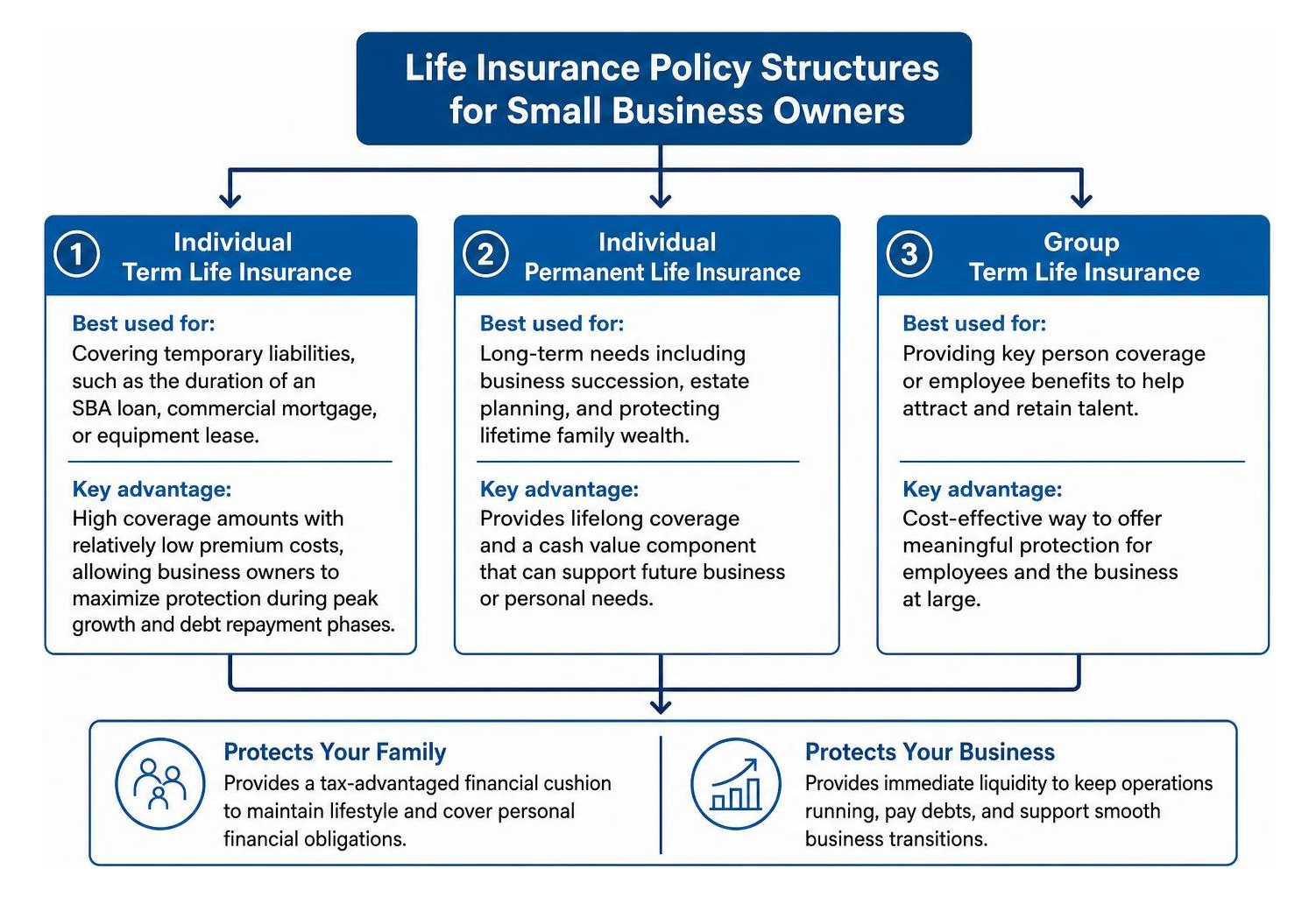
1. Individual Term Life Insurance
Term life insurance provides coverage for a specific period, often ranging from 10 to 30 years. It may offer a straightforward death benefit with premiums set according to the policy’s terms.
- Often considered for: Temporary liabilities, such as the duration of an SBA loan, commercial mortgage, or equipment lease.
- Potential advantage: It may allow business owners to seek substantial coverage during peak growth and debt-repayment phases, subject to underwriting, policy design, and affordability.
2. Individual Permanent Life Insurance
Permanent life insurance—such as whole life or universal life—can provide long-term coverage and may remain in force for life if required premiums are paid and policy requirements are met. These policies may also include a cash value component that can grow on a tax-deferred basis over time, depending on policy design and carrier performance.
- Often considered for: Long-term succession planning, key person retention, estate equalization among heirs, or permanent family income replacement.
- Potential advantage: It may support long-term protection and include cash value that policyholders may access through loans or withdrawals, subject to policy terms and potential tax implications.
3. Small Group Term Life Insurance
If your business has employees, offering group life insurance may strengthen a benefits package while providing a base level of protection for eligible employees. Availability, benefit amounts, eligibility rules, conversion options, and related features vary by carrier and plan.
| Policy Type | Primary Purpose | Duration | Cash Value Accumulation | Underwriting Approach |
|---|---|---|---|---|
| Individual Term Life | Debt protection, loan collateral, income replacement | Fixed period | No | Individual medical and financial underwriting may apply |
| Individual Permanent Life | Long-term protection, estate liquidity, key person funding | May continue for life if policy requirements are met | May be available, depending on policy type | Comprehensive individual underwriting may apply |
| Group Term Life | Employee benefits and baseline protection | Generally tied to plan participation or employment | No | Eligibility and underwriting vary by carrier and plan |
To evaluate how these structures fit your situation, explore our educational resources on customized life insurance options and fundamental life insurance mechanics.
Individual Coverage vs. Group Life Benefits
Small business owners often wonder whether group life insurance through their company is sufficient, or whether they should also consider an individual policy. While group life can provide a convenient foundation, it has distinct limitations when compared with individual ownership:
- Portability: Group life is generally tied to the employer or plan. If the business closes, is sold, or you step down, coverage may end or conversion may be available under the plan’s terms.
- Coverage Limits: Group coverage may not be sufficient for personal mortgages, family living expenses, or substantial business obligations; available benefit amounts vary by plan.
- Plan Rules: Eligibility, participation, employer contributions, and conversion provisions differ by carrier and plan.
Many business owners consider combining personally owned individual coverage for family protection with employer-sponsored group life for workplace benefits, depending on their needs and the available policies.
How Can Life Insurance Safeguard Your Family’s Financial Well-Being?
For Vietnamese entrepreneurs, business success is deeply connected to family prosperity. The revenue generated by your business may support multi-generational households, contribute to your children’s education, and build long-term security. If an owner dies unexpectedly, an interruption in business cash flow may put added pressure on those personal goals.
A personal life insurance policy can serve as a financial resource for loved ones that is separate from the operational risks of the business:
- Income Replacement: A death benefit may provide funds toward everyday household expenses, property taxes, health care costs, and other needs.
- California Mortgage Obligations: Housing costs in California can be one of the largest expenses for families. Policy proceeds may help a family address an existing mortgage or other housing-related obligations.
- Education Funding: Proceeds may help fund college tuition and living expenses for children, depending on the family’s priorities and circumstances.
To explore how to balance coverage sizes and household budgets, review our insights on protecting families and parents and our guide to compare life insurance options and costs for Vietnamese families.
Protecting Personal Guarantees and Family Assets
One of the most overlooked risks for small business owners is the personal guarantee. When leasing commercial property in California or securing an equipment loan, landlords and lenders may require owners to sign personal guarantees.
If an owner dies:
- Business obligations may continue. The effect of a death on an outstanding loan or guarantee depends on the agreement, the business structure, the estate, and applicable law.
- The owner’s estate may face financial exposure. A personal guarantee can create added financial risk for the estate or family, depending on the facts and governing documents.
- Life insurance may provide a source of funds. An individual term or permanent policy may help provide liquidity toward personally guaranteed obligations, depending on the policy, beneficiary arrangement, and circumstances.
Business owners should seek qualified legal or financial guidance for questions about guarantees, estate exposure, and the treatment of specific obligations.
How Does Life Insurance Secure Business Continuity and Buy-Sell Agreements?
If your business has multiple partners or shareholders, planning for unexpected death or disability can be important for commercial continuity. Without a formal succession framework, a deceased partner’s ownership shares may pass to their legal heirs. This can create difficult situations if surviving owners must work alongside family members who do not want an operating role, or if heirs need liquidity from illiquid business shares.
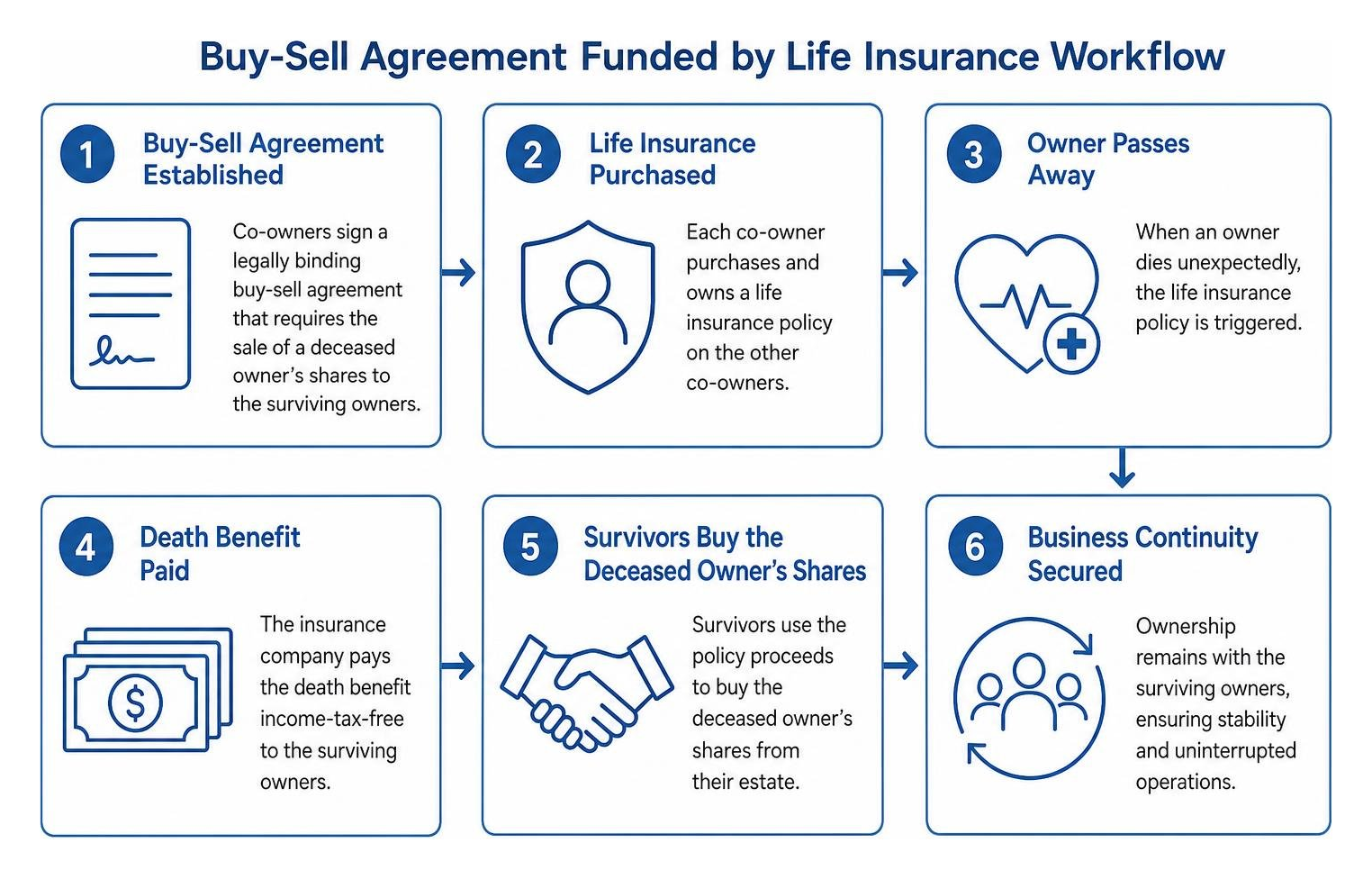
Life-Insurance-Funded Buy-Sell Agreements
A buy-sell agreement is a legally binding contract between co-owners that addresses how an owner’s share of the business may be transferred if they die, become disabled, or retire. Life insurance may be used as one funding source for a properly structured buy-sell agreement, helping create potential liquidity for an ownership transition when a covered owner dies.
There are two primary structures:
- Cross-Purchase Plan: Each co-owner purchases and owns a life insurance policy on the other owners. If an owner dies, the surviving owners may receive policy proceeds and use them to purchase the deceased owner’s shares from the estate, subject to the agreement and policy terms.
- Entity-Purchase (Stock Redemption) Plan: The business entity purchases, owns, and pays for policies on each owner. If an owner dies, the business may receive the death benefit and use available funds toward redeeming the deceased owner’s equity, subject to the agreement and policy terms.
Potential Benefits of a Life-Insurance-Funded Buy-Sell Agreement
- May help provide liquidity for heirs: A properly structured agreement and funding arrangement may help an owner’s family receive cash for an ownership transition rather than retaining only illiquid business shares.
- May support operational control: Surviving partners may be better positioned to retain ownership and operational control under the terms of the agreement.
- May reduce pressure for emergency financing or asset sales: Available policy proceeds may help reduce the need to sell assets or seek emergency financing, depending on the business’s obligations and circumstances.
Key Person Life Insurance
In many Vietnamese small businesses, specific individuals drive a substantial portion of sales, technical execution, or executive leadership. Key person insurance is generally a policy taken out by the business on the life of a vital employee or founding owner.
- The business may own the policy, pay premiums, and be the beneficiary, depending on the arrangement.
- If the key person dies, proceeds may help with operating costs, lost revenue, recruiting, training, or other transition needs, depending on the policy and business circumstances.
To learn more about these continuity tools, explore our detailed articles on the role of insurance in your business succession plan and our guide to key person life insurance basics.
How Can You Select and Structure the Right Coverage for Your California Business?
Structuring life insurance for a small business requires an accurate assessment of personal obligations, commercial liabilities, and ownership agreements.

Here is a structured sequence to help evaluate appropriate coverage:
- Calculate Total Business Liabilities: Identify outstanding commercial loans, SBA debt, equipment leases, and personal guarantees.
- Evaluate Buy-Sell Funding Requirements: Review the business valuation approach and consider the capital that may be needed for an ownership transition.
- Assess Key Person Replacement Costs: Estimate the potential revenue impact and recruiting or training costs if a vital team member or founder were lost.
- Determine Family Income Replacement Needs: Consider household mortgage obligations, living expenses, and children’s educational funding needs.
- Evaluate Group Benefits for Employees: Consider whether group term life may fit your employee-benefits approach, recognizing that plan features and availability vary.
- Coordinate with Professional Advisors: Consult a qualified CPA regarding tax considerations and a qualified attorney regarding estate-planning or entity-structure questions.
Coordinating with Broader Estate and Financial Strategies
Life insurance policies do not operate in a vacuum. To help ensure death benefits are distributed according to your wishes and to understand potential probate considerations in California, beneficiary designations should be reviewed alongside your broader estate plan. You can learn more by reading our guide to estate planning for Vietnamese families and reviewing broader financial strategies and estate planning concepts.
Licensed life insurance agent Leo Truong helps individuals and business owners understand and review available life insurance options for California small business owners.
Frequently Asked Questions About Life Insurance for Small Business Owners?
Can a California small business deduct life insurance premium payments as an operating expense?
Tax treatment of business-owned, key person, buy-sell, or employee life insurance can vary based on the policy, ownership arrangement, beneficiary designation, and business circumstances. Business owners should consult a qualified tax professional or CPA for advice specific to their situation.
What is the difference between personal life insurance and key person life insurance?
The main difference lies in policy ownership, beneficiary designation, and intended purpose:
- Personal Life Insurance: Often owned by the individual or a family trust, paid for from personal funds, and payable to family members. It may help replace household income, address mortgage obligations, and support dependents.
- Key Person Life Insurance: Often owned and paid for by the business entity, with the company named as beneficiary. It may help the business address the financial effects of losing a critical revenue generator, including operating costs, lost revenue, recruiting, or transition needs, depending on the policy and circumstances.
What Are the Next Steps to Protect Your Enterprise and Loved Ones?
As a Vietnamese small business owner in California, your enterprise represents years of hard work, dedication, and sacrifice. Taking a proactive approach to risk management can help you consider how an unexpected event could affect both your commercial enterprise and your family.
Individual life insurance, key person coverage, buy-sell funding, or employee life insurance may each form part of a broader business and family protection strategy, depending on your needs, policy structure, and circumstances.
To explore policy structures and review available options, connect with licensed life insurance agent Leo Truong at Plan With Leo for clear, educational guidance tailored to your commercial and family needs.