The Ultimate Guide to Life Insurance for First-Time Homeowners

Do First-Time Homeowners Need Life Insurance?
Why Taking on a Mortgage Changes Your Financial Protection Needs
Purchasing a first home is a significant financial milestone. Taking on a residential mortgage often represents one of the largest financial commitments a household will make. When you assume a home loan, ongoing housing payments, property obligations, and maintenance expenses become part of your long-term responsibilities. For couples, co-borrowers, or growing households, ensuring that a surviving partner or family member is not left with overwhelming debt if an income earner passes away is an important consideration.
Securing personal life insurance can help establish a financial buffer separate from basic property coverage or group benefits provided by employers. This is particularly relevant for families and parents who want to help protect their loved ones from potential financial strain during difficult transitions.
Evaluating life insurance as a new homeowner can be valuable for several practical reasons:
- Shared Financial Responsibilities: If you buy a home with a co-borrower or spouse, the surviving owner may become solely responsible for monthly payments, property taxes, and home maintenance. A life insurance benefit can provide funds to help cover ongoing housing costs.
- Final and Secondary Expenses: In addition to mortgage debt, unexpected end-of-life expenses and immediate household costs can create sudden financial pressure. Having personal coverage can assist surviving family members in managing these needs without relying entirely on emergency savings.
- Understanding Group Policy Limits: While many individuals have coverage through work, employer-sponsored group life insurance may have limited benefit amounts and might not remain active if you change employers. Personal coverage remains under your individual control.
How Life Insurance Differs From Other Home Coverages
When purchasing a home, buyers encounter several distinct insurance terms:
- Homeowners Insurance: Required by lenders to cover structural damage to the property, personal belongings, and general liability. It does not provide financial benefits upon the death of a homeowner.
- Mortgage Protection Insurance (MPI): Often offered by lenders, MPI is specifically designed to pay off a mortgage balance upon death. However, benefits are usually paid directly to the lender rather than to your chosen family members.
- Private Mortgage Insurance (PMI): According to standard guidance from the Consumer Financial Protection Bureau, PMI protects the lender if a borrower defaults on a loan with a low down payment. It provides no payout or benefit to the homeowner’s family.
- Personal Individual Life Insurance: An individual term or permanent policy allows you to name primary beneficiaries, such as a spouse or trust. Beneficiaries receive a payout that they can use flexibly according to their financial priorities.
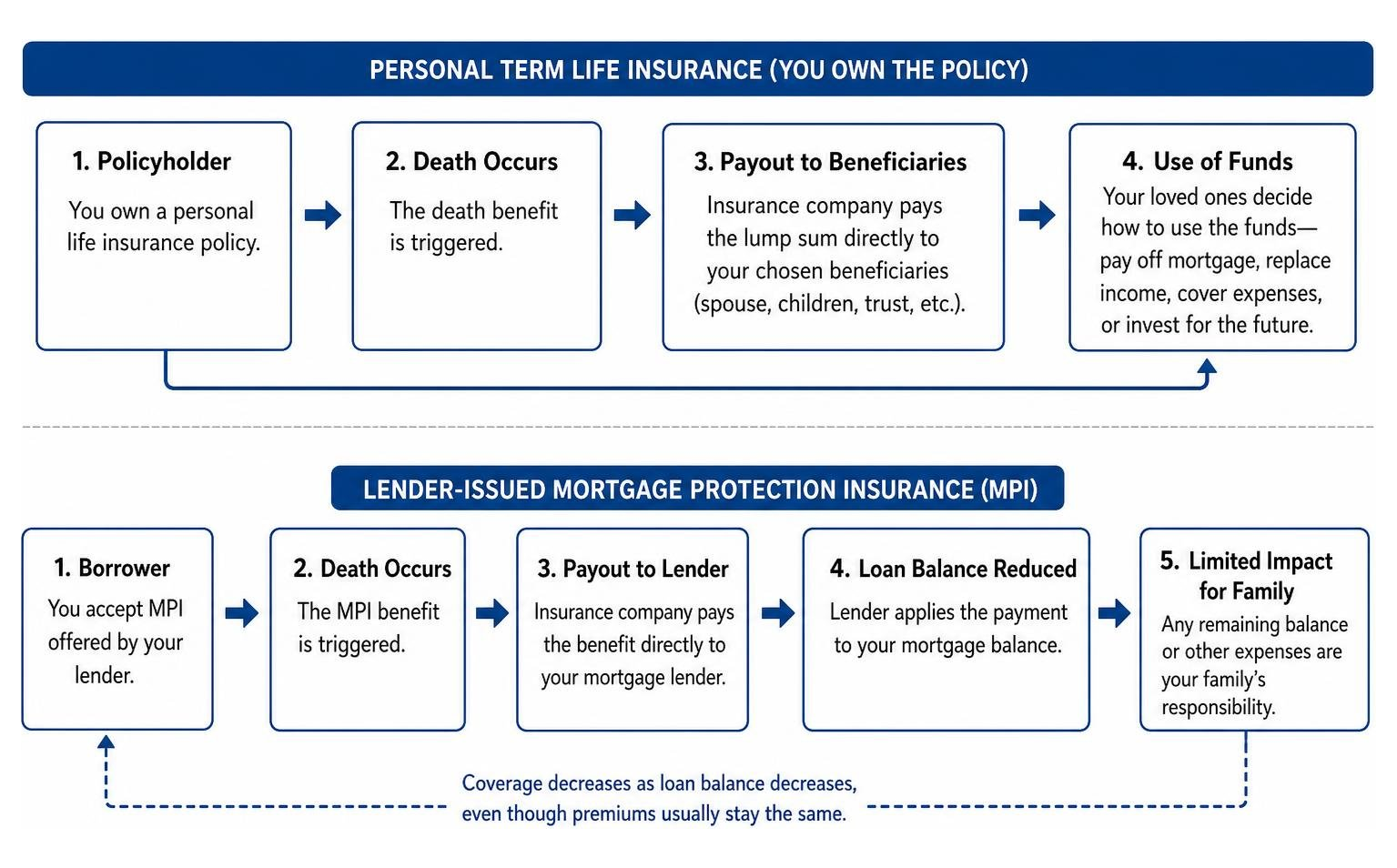
Key Policy Differences at a Glance
| Feature | Personal Term Life Insurance | Bank Mortgage Protection (MPI) | Homeowners Insurance | Private Mortgage Insurance (PMI) |
|---|---|---|---|---|
| Primary Target | Chosen beneficiaries | Mortgage lender | Physical property & structure | Mortgage lender |
| Payout Recipient | Named beneficiaries | Directly to lender | Homeowner / repair contractor | Mortgage lender only |
| Benefit Usage | Flexible according to policy terms | Restricted to mortgage debt | Restricted to property repairs | No benefit for family |
| Portability | Remains active if you move, per terms | Tied to specific loan | Tied to specific property | Canceled after equity milestone |
| Lender Requirement | Optional personal decision | Optional | Typically required by mortgage lenders | May be required depending on the loan and down payment |
What Types of Life Insurance Might First-Time Buyers Consider?
For many first-time homebuyers, individual term life insurance provides a straightforward and structured option. Term life insurance offers coverage for a designated duration—commonly 10, 15, 20, or 30 years—with fixed premiums during the active term period.
When evaluating coverage after buying a home, some buyers consider the mortgage timeline along with income replacement needs, dependents, and other household responsibilities.
- 30-Year Term Policy: Often considered by buyers taking out a traditional 30-year fixed loan to maintain coverage throughout the primary repayment period.
- 15- or 20-Year Term Policy: Suitable for buyers with shorter loan durations or those whose dependent family members may reach financial independence sooner.
Because term policies focus purely on death benefit protection without complex investment mechanisms, they generally offer lower initial premium costs compared to permanent insurance options.
Comparing Level Term vs. Decreasing Term Coverage
First-time buyers evaluating coverage options may encounter two main term structures:
- Level Term Life Insurance: The coverage amount remains constant throughout the entire term. For example, a policy selected at home purchase maintains the same payout value regardless of when a claim occurs during the policy term. As the mortgage balance decreases, the fixed benefit leaves an increasing portion of funds available for other household expenses.
- Decreasing Term Life Insurance: The policy payout gradually reduces over time, typically mirroring a scheduled mortgage payoff. While decreasing term insurance may match a reducing debt balance, it offers less flexibility because the remaining benefit decreases alongside the loan principal.
Co-buyers may compare two individual policies with a joint policy. The appropriate structure depends on each person’s coverage needs, budget, and policy terms.
How Much Life Insurance Coverage Do You Need for Your New Home?
Determining an appropriate coverage amount involves assessing your household’s overall financial obligations rather than looking solely at the remaining loan balance. A thoughtfully structured life insurance policy helps cover immediate housing commitments while supporting ongoing living standards.

When evaluating potential coverage amounts, homeowners typically consider several key categories:
- Outstanding Mortgage Principal: The total remaining balance needed to satisfy the primary home loan.
- Income Replacement Needs: Financial support intended to help replace ongoing earnings for dependent family members.
- Other Outstanding Debts: Auto loans, personal loans, or personal obligations that could place strain on surviving relatives.
- Future Household Expenses: Property taxes, home maintenance, utilities, and daily living costs.
- Final Expenses: Funeral costs and administrative obligations associated with settling personal affairs.
Evaluating coverage for life insurance for new parents requires carefully balancing long-term living costs alongside mortgage debt.
Estimating Your Household Coverage Baseline
To calculate a baseline coverage level without complex formulas, homeowners can combine their total mortgage obligation with a reasonable estimate of future living expenses and secondary debts, minus existing liquid savings.
For example, combining a home loan balance with several years of household income replacement provides a general starting point. Adjusting this total based on family size and secondary obligations allows buyers to select a policy benefit that fits their budget.
Applying for coverage earlier in adulthood generally offers premium cost benefits, as life insurance rates depend heavily on age and overall health. Securing policy terms early can help households maintain stable protection while responsibilities evolve.
What Happens to Your Mortgage If You Die Without Life Insurance?
If an income earner passes away without life insurance coverage, surviving family members and estate representatives must determine how to manage remaining mortgage debt. A mortgage generally does not disappear automatically after death, but the specific outcome may depend on several factors, including whether there is a co-borrower, how the property is owned, the mortgage agreement, the estate, and applicable law.
Because these issues can vary by household and jurisdiction, mortgage, ownership, and estate questions should be discussed with a qualified legal or mortgage professional.
Structuring Beneficiary Designations
To simplify transfer processes and support loved ones, policyholders should pay attention to how their life insurance coverage is established:
- Primary and Contingent Beneficiaries: Naming clear primary and secondary beneficiaries helps ensure policy benefits can be distributed directly to designated individuals according to carrier guidelines.
- Reviewing Ownership Structures: Coordinating policy arrangements with a qualified professional can help ensure beneficiary details align with intended personal goals.
When Might a First-Time Homebuyer Review Life Insurance?
Some prospective buyers choose to review life insurance options during the home purchase process, often between contract signing and final loan closing. Reviewing coverage during this period can help buyers understand how a new mortgage may affect their household’s broader protection needs.
Delaying coverage decisions until after moving in can lead to oversight, as moving logistics, home projects, and routine responsibilities take priority. Delaying applications may also expose households to unexpected risks or result in higher premiums as age advances.
Step-by-Step Guide to Applying Before Closing
Homeowners can follow a structured process to coordinate coverage alongside their purchase:
- Gather Basic Financial Details: Review total mortgage amounts, household income, personal health history, and secondary debts.
- Determine Coverage Limits and Duration: Select a policy term that aligns with your loan schedule and select an appropriate benefit amount.
- Compare Policy Options: Work with a licensed life insurance agent to review available life insurance options.
- Complete Underwriting Requirements: Submit application forms and health information as required by carrier underwriting guidelines.
- Establish Policy Start Date: Coordinate with your agent to understand when coverage may become effective.
Working with a licensed life insurance agent like Leo Truong helps buyers understand and compare available life insurance options based on their family’s timeline and monthly budget.
Frequently Asked Questions About Life Insurance for Homeowners
Is life insurance mandatory to get a mortgage approval?
No. Life insurance is generally not required by mortgage lenders or state regulations as a condition for home loan approval. Lenders typically require homeowners property insurance and may require private mortgage insurance (PMI) if down payments are below specified thresholds. While life insurance is optional from a lender standpoint, many buyers consider it a useful personal safety net.
Can I use personal term life insurance instead of bank mortgage insurance?
Yes. Personal term life insurance offers flexible protection where policy proceeds are paid to your designated beneficiaries rather than directly to the mortgage lender. Beneficiaries can evaluate how best to allocate funds, whether paying down mortgage principal, replacing ongoing income, or addressing other financial commitments. Personal policies also remain active if you refinance or relocate, subject to policy terms.
How does homeownership itself affect life insurance premium rates?
Owning real estate does not directly increase base life insurance premium rates. Underwriting evaluations depend primarily on factors such as age, medical history, family health history, tobacco use, occupation, and lifestyle activities. However, choosing a higher coverage limit to match a larger mortgage obligation will affect overall policy premiums.
How Can You Get Started with Life Insurance for Your First Home?
Purchasing your first home is a significant achievement. Taking time to review personal life insurance options helps ensure that your housing commitment remains supported over the long term.
Selecting appropriate life insurance coverage may help homeowners protect the people who could be affected financially if they died. As household responsibilities change through family growth, career transitions, or other financial milestones, reviewing coverage can help ensure protection remains aligned with current needs.
To explore options for your new home, visit our faq section to learn more about coverage mechanics, or reach out directly through our contact page to request a personalized quote today.
Educational Disclaimer: This article is strictly for informational and educational purposes and does not constitute formal financial, legal, tax, or mortgage advice. Individual policy eligibility, premiums, underwriting requirements, and coverage options vary by insurance carrier, state jurisdiction, age, and individual health history. Please consult with a licensed life insurance agent and professional tax or legal advisor to evaluate your specific individual circumstances.